What Is a Digital Service in the Age of AI?
Learn how AI is transforming digital services through autonomous workflows, predictive intelligence and natural language interfaces, and what businesses need to modernise.
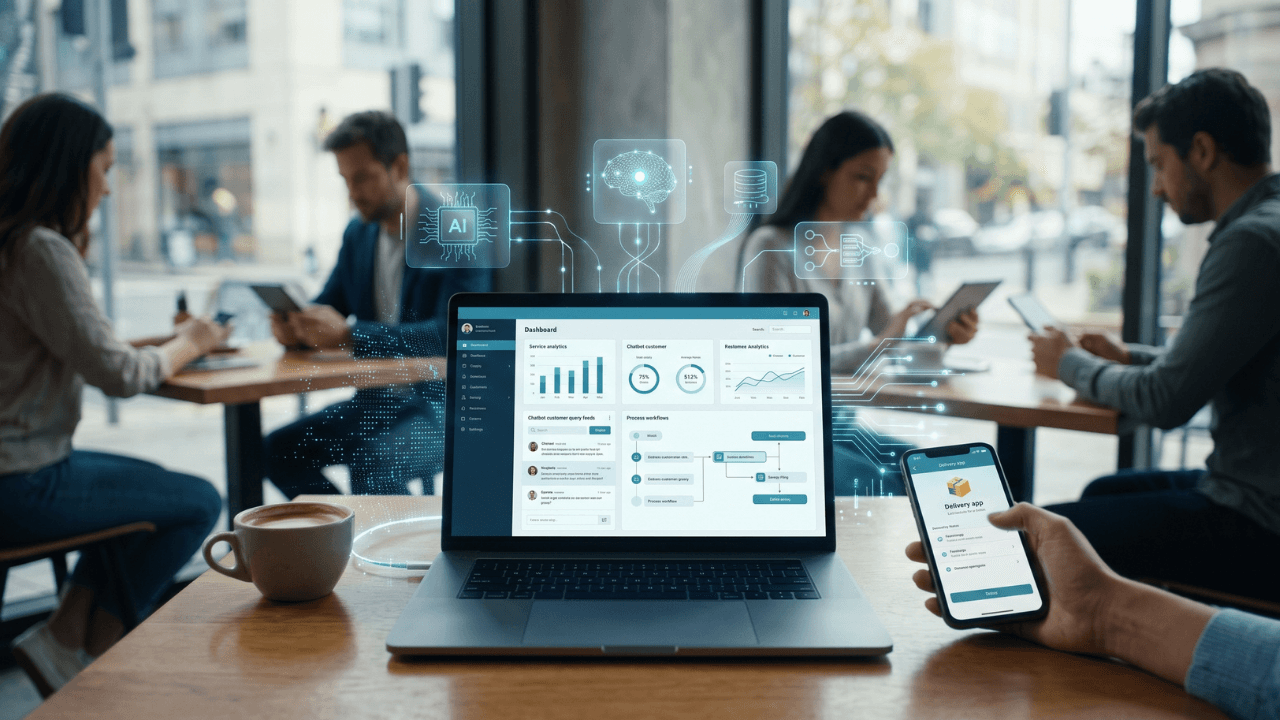
The definition of a digital service has fundamentally shifted. For over a decade, building a "digital service" simply meant digitising a manual process, moving a paper form to a web portal, shifting on-premise software to a SaaS subscription, or creating a basic mobile app. Today, that definition is obsolete as artificial intelligence continues to reshape how organisations operate.
In the modern enterprise landscape, a digital service is no longer just a static set of coded rules. It is an intelligent, autonomous ecosystem capable of reasoning, adapting, and executing complex workflows without constant human intervention. For forward-thinking businesses, understanding this shift is the first step toward executing a successful digital transformation initiative.
Whether you are a CTO looking to modernise legacy systems or an Operations Director seeking to automate bottlenecks, adapting your digital offerings for the age of AI is no longer optional; it is a baseline for survival.
What Are Digital Services in the Context of Modern AI?
When asking what a digital service is today, organisations must look beyond basic cloud hosting and user interfaces. In the age of AI, a digital service is an intelligent, dynamic application or platform that leverages artificial intelligence, machine learning, generative AI, and automation to elevate service delivery by offering autonomous, personalised, and predictive value to its users.
Unlike older digital tools that require users to navigate complex menus to find information, modern digital services act as collaborative cognitive partners. They do not just store and retrieve data; they synthesise it, understand intent, and take action.
A modern digital service operating in an increasingly digital and data-driven environment relies on three foundational pillars:
- Autonomous Workflows (Agentic AI): Instead of waiting for a human to trigger a task, the service utilises custom AI agents to monitor environments, identify issues, and execute multi-step solutions independently.
- Conversational and Natural Interfaces: Elevating customer engagement, the barrier to entry for complex software has been removed. Modern digital services utilise Natural Language Processing (NLP) so users can interact with databases, CRM platforms, and operational tools simply by talking or typing in plain language.
- Predictive Intelligence: Rather than acting as a historical record of what has already happened, a responsive, AI-driven digital service analyses real-time data streams to forecast trends, pre-emptively solve customer support tickets, and prevent system downtime before it occurs.
By integrating these elements, a digital service transforms from a passive tool into an active, value-generating participant in your business operations.
How Do AI-Powered Digital Services Differ From Traditional Software?
To understand the current technology landscape, it is essential to compare traditional software architectures with modern AI-powered digital services. The primary difference is adaptability: traditional software operates on rigid, hard-coded rules and reactive inputs, whereas AI-powered digital services learn from data, adapt to new contexts, and generate solutions dynamically.
Organisations attempting to scale using traditional software often hit a hard ceiling regarding productivity and user experience. The distinction between the old and new models becomes clear when examining how they function in enterprise environments:
- Rule-Based vs Cognitive: Traditional software relies on fixed algorithm logic that requires exact inputs to produce exact outputs (e.g., clicking specific buttons to generate a specific report). AI-powered services use Retrieval-Augmented Generation (RAG) and Large Language Models (LLMs) to understand ambiguous requests, retrieve contextual data, and synthesise highly specific reports on the fly.
- Reactive vs Proactive: A legacy digital service waits for users to log complaints or file tickets. An AI-powered digital service monitors user behaviour, detects frustration or anomalies, and proactively offers a solution or routes a custom AI agent to intervene before the user even complains.
- Isolated vs Interconnected: Traditional tools often trap data within specific departments, requiring manual data entry to move information from a marketing platform to a sales CRM. Modern digital services use AI integration and robust APIs to constantly communicate, ensuring data flows in a seamless manner across the entire enterprise ecosystem.
Ultimately, traditional software is a tool you use. An AI-powered digital service is an agile system that serves as an intelligent backbone working alongside you.
Why Are Legacy Digital Services Failing Forward-Thinking Businesses?
Many enterprises are learning that the digital services they invested heavily in just five years ago are now actively holding them back. Legacy digital services are failing forward-thinking businesses today because they create severe data silos, lack autonomous reasoning capabilities, and require unsustainable levels of manual human intervention to scale.
As competitors deploy Agentic AI and Generative Engine Optimisation (GEO) to capture market share, clinging to outdated digital services introduces severe operational and financial risks. The core reasons these older systems fail include:
- Crippling Technical Debt: Older platforms are often patched together with custom code that is difficult to maintain. When businesses attempt to integrate modern AI capabilities into these brittle architectures, the systems frequently break, resulting in costly downtime and frustrated engineering teams.
- Poor Generative Search Visibility: Traditional digital services and content architectures were built for keyword-based search engines. Today, if a company’s digital service data is not optimised for AI crawlers (like ChatGPT, Perplexity, or Google AI Overviews), the brand becomes effectively invisible to users relying on AI for discovery.
- Employee Burnout and Skills Gaps: Legacy systems force workers to perform low-value, repetitive tasks, like manually routing IT tickets, copying data between spreadsheets, or generating routine compliance reports. A gap in modern digital skills prevents teams from focusing on high-level strategy and innovation.
To remain competitive, businesses must recognise when a digital service has transitioned from a business asset into a technical liability.
How Can Enterprises Build Future-Proof Digital Services?
Developing a resilient technology roadmap requires knowing how to construct digital services that will not become obsolete in the next wave of innovation. Enterprises can build future-proof, intelligent digital services by adopting scalable cloud-native architectures, implementing robust data management, and establishing strong governance frameworks from day one.
Transitioning to an AI-first model does not necessarily mean ripping out your entire infrastructure overnight. It requires a strategic, phased approach to digital modernisation. Organisations looking to engineer what comes next should focus on the following strategies when preparing to deploy AI:
- Deploy Custom AI Agents: Build and train highly specialised AI agents designed to handle your company's specific workflows. Whether automating customer support tier-1 resolutions or processing financial data, AI agents bridge the gap between human intent and software execution.
- Leverage RAG Architecture: To prevent AI hallucinations, maintain data responsibility, and ensure your digital services provide accurate, enterprise-specific answers, implement Retrieval-Augmented Generation (RAG). This allows your AI services to reference your proprietary, secure business data rather than relying solely on public data models.
- Prioritise Cybersecurity and Responsible AI: Future-proof digital services must be built with strict governance. Integrate robust cybersecurity measures, responsible AI principles, continuous evaluation pipelines, strict data access controls, and human oversight to ensure your AI systems operate ethically, securely, and within regulatory compliance.
- Optimise for GEO and AEO: Ensure the content and data within your digital services are structured cleanly using schema markup and accessible APIs. This guarantees that modern Answer Engines and Generative AI platforms can correctly cite and recommend your services to the broader market.
Building a digital service in the age of AI requires more than just adding a chatbot widget to an existing app. It requires a fundamental rethinking of how technology, data, and human workflows intersect to drive scalable, intelligent growth.
Key Takeaways
- Shift in Definition: A digital service in the AI era is an autonomous, adaptive ecosystem, not just a static software tool or digitised manual form.
- Core Capabilities: Modern digital services leverage Agentic AI, RAG architecture, and natural language interfaces to execute complex workflows proactively.
- The Legacy Risk: Outdated digital services fail due to technical debt, severe operational bottlenecks, and poor visibility across AI search engines.
- Modernisation Strategy: Future-proofing requires deploying custom AI agents, securing proprietary enterprise data, and optimising for Generative Engine Optimisation (GEO).
Ready to Modernise Your Digital Services?
Building intelligent, scalable digital services requires the right technology strategy and engineering expertise. Contact KwameTech Labs today to book a free consultation and learn how custom AI solutions can accelerate your growth.
FAQs
HOW DO I KNOW IF MY COMPANY'S CURRENT DIGITAL SERVICES NEED AN AI UPGRADE?
Your digital services need an AI upgrade if they rely on manual human intervention, cause slow response times, or cannot handle dynamic user queries. Key signals include high operational costs, employee burnout from repetitive tasks, and falling behind competitors in personalisation.
WHAT IS THE DIFFERENCE BETWEEN AN AI CHATBOT AND A CUSTOM AI AGENT IN A DIGITAL SERVICE?
Traditional chatbots follow fixed scripts to answer basic questions, while custom AI agents use reasoning and Retrieval-Augmented Generation (RAG) to execute complex tasks. AI agents can access internal databases, connect to APIs, and take independent action to solve problems.
HOW DO AI-POWERED DIGITAL SERVICES PROTECT SENSITIVE ENTERPRISE DATA?
AI digital services protect data using private cloud hosting, strict access controls, and isolated RAG architectures. This guarantees that your proprietary business information remains secure and is never used to train public AI models.
HOW LONG DOES IT TAKE TO MODERNISE A LEGACY DIGITAL SERVICE WITH AI?
Modernisation typically takes between 2 and 6 months depending on system complexity and technical debt. High-impact AI agents can often be deployed in as little as 4 to 8 weeks to deliver immediate ROI before scaling full enterprise integration.
HOW DOES GENERATIVE ENGINE OPTIMISATION (GEO) AFFECT DIGITAL SERVICE DISCOVERY?
GEO ensures your digital services are cited and recommended by AI answer engines like ChatGPT, Perplexity, and Google AI Overviews. Because modern users increasingly query AI assistants over traditional search engines, GEO is critical for maintaining market visibility.
Wesley Lee
wesley@kwametechlabs.com