How Agentic AI Outperforms Basic AI Chatbots in Support
Discover how agentic AI transforms customer support beyond traditional chatbots. Explore how intelligent AI agents resolve complex queries, automate workflows, and deliver faster, more personalised customer experiences.
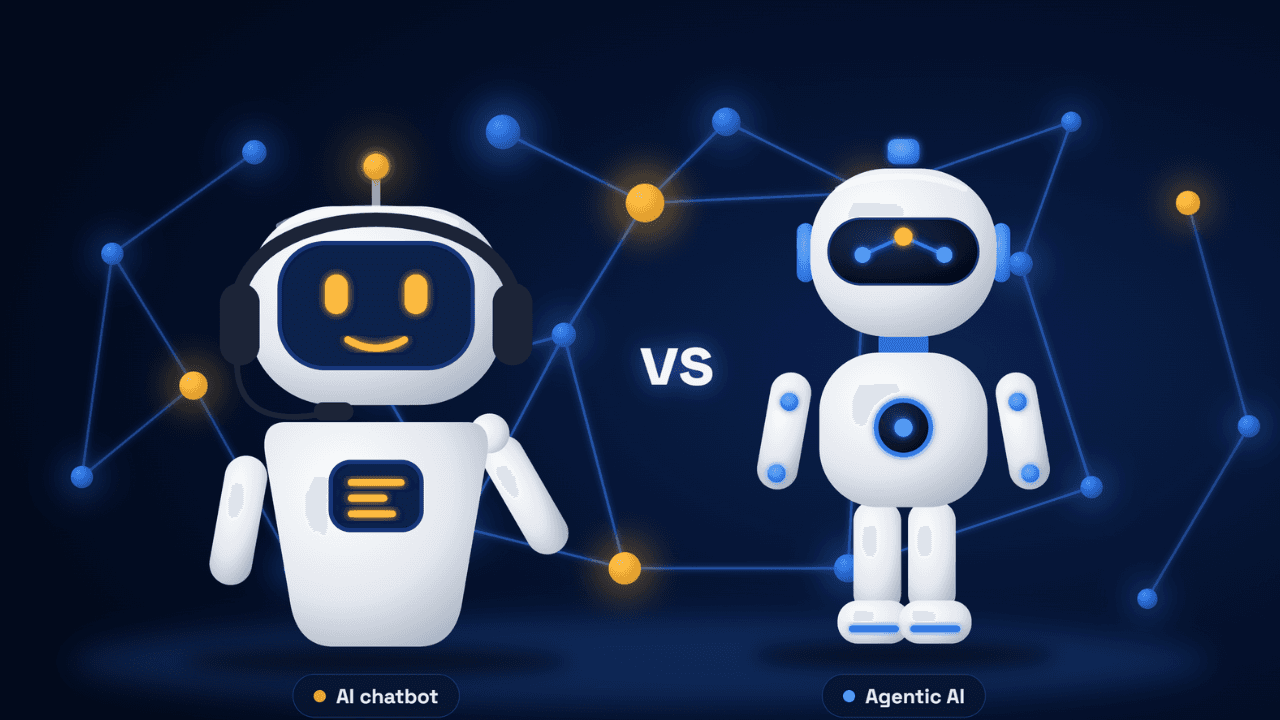
Powered by advanced AI technology, smart support systems are replacing rigid scripts. Instead of forcing users down pre-set options, the AI reads your plain-text requests, understands customer mood, and connects directly with company software to complete tasks. For leaders building the future of customer service, these smart systems provide the foundation to scale up, boost team productivity, and deliver better overall support.
Customer support has hit a major turning point. For years, businesses relied on basic, rule-based chatbots to block support tickets from reaching staff. This created a frustrating experience for users because of rigid rules, endless loops, and frequent dead ends. Today, customers expect much better support, and conversational AI has become far more advanced. Simply turning users away is no longer acceptable. Forward-thinking organisations are moving away from passive assistants and adopting proactive, effective AI support systems.
Key Takeaways
- System evolution: AI agents go far beyond basic AI chatbots. They combine clear reasoning, smart search, and the ability to complete multi-step tasks across connected tools automatically.
- Solving real issues: Legacy chatbots try to divert questions without fixing the core problem. Smart AI agents, on the other hand, complete tasks from start to finish.
- Better efficiency: Smart AI setups resolve over 75% of issues on the first try, speeding up answer times and cutting down on repetitive human tasks.
- Reliable enterprise guardrails: Agents connect with internal business data and safety rules, ensuring answers remain accurate and on-brand without making things up.
What Is The Design Difference Between Agentic AI vs AI Chatbots?
The key difference between a basic AI chatbot and an agentic AI is that a traditional chatbot follows strict, pre-set rules, while an AI agent works independently to solve goals and use tools step by step.
Traditional chatbots rely on standard decision trees or keyword matching. When a user asks a question, the bot checks for specific keywords to send back a canned response. If the query doesn't match the expected wording, it fails and passes the issue to a human. Traditional bots can only read standard templates; they cannot remember past context, learn from customer history, or update company records.
In contrast, Custom AI Agents & Automation use smart problem-solving techniques. When facing a complex question, the agent looks beyond keywords, using full context to figure out the right solution step. It searches internal databases, retrieves up-to-date details, and triggers actions across linked systems.
Unlike basic AI chatbots that only paste text from policy documents, smart AI agents can converse, verify customer accounts, check purchase records, confirm warranty rules, generate shipping labels, and update records instantly. By connecting AI directly to backend processes, interactions become natural, accurate, and truly helpful.
Why Are Legacy Support Chatbots Failing Modern Customers?
Legacy chatbots fall short because they lack the reasoning power needed for great experiences. They operate in isolated systems and focus on deflecting tickets rather than solving user problems.
In the past, chatbot success was measured by how many users left without asking for a human agent. However, this metric was misleading; users often walked away out of frustration after getting stuck in loops. Older bots could not read or write data across tools like billing software, inventory systems, or customer records. This forced customers to repeat information endlessly, causing frustration and hurting brand loyalty.
As businesses pursue Digital Transformation Services, keeping outdated chatbots creates costly technical work. Any change to products or rules forces developers to manually rewrite flowcharts. When volume spikes, or unusual cases arise, old systems break down completely, leading to ticket backlogs, long wait times, and declining satisfaction. To stay competitive, companies need flexible systems that understand context rather than relying on rigid scripts.
How Do AI Agents Improve Key Customer Support Metrics?
Smart AI agents improve key support metrics by solving over 75% of issues on first contact, cutting wait times from hours to seconds, and lowering basic support costs significantly.
Traditional support relies on limited human hours and high labour costs. Scripted bots only deflect 15–20% of basic questions. In contrast, smart AI agents resolve complex requests directly at ingestion by linking into company databases and taking end-to-end actions without extra handoffs.
Organisations that optimise their support desks with custom agentic workflows achieve transformative operational gains across several core benchmarks:
- First Contact Resolution: Complex questions get answered during the initial chat, removing the need for long ticket escalations.
- Faster resolutions and handle times: Processing common requests (order updates, account changes, scheduling) drops from days to nearly instant responses.
- Lower cost per ticket: Handles standard and repetitive questions automatically, reducing support costs so human teams can focus on high-value issues.
- Customer Satisfaction (CSAT): provides instant, personalised and accurate answers 24/7, eliminating queue times and creating a truly seamless customer experience.
- Technical Troubleshooting: Runs diagnostic checks through system logs and guides users step-by-step to solve technical problems.
- Focusing human empathy where needed: takes over repetitive data entry, freeing staff to give personal care to delicate customer conversations.
By automatically turning customer requests into system actions, businesses scale up efficiently without needing to hire linearly as ticket volume grows.
How Can Enterprises Safely Deploy AI Agents Across Their Support Workflows?
Enterprises can safely launch smart AI across support workflows by combining accurate internal search, safety rules, permission controls, and human oversight.
Deploying AI into critical workflows carries risks like false answers or data leaks. The fix is anchoring AI models to internal company documentation, past resolutions, and secure internal databases using modern Full-Stack Software Development Services and standards, avoiding reliance on general public web data.
A comprehensive enterprise deployment roadmap incorporates several critical safety layers:
- Policy Enforcement and Rules: Automatic safety layers prevent the AI from stepping outside company policies, legal guidelines, or brand voice standards.
- Role-Based Access Controls: System permissions ensure models only access the specific data needed, preventing unauthorised database changes or data exposure.
- Testing and Simulations: Before going live with real customers, engineering teams run simulated conversations across thousands of test cases to verify performance and response accuracy.
- Confidence Scoring: Built-in scoring measures certainty before answering. If confidence is low, the request automatically transfers smoothly to a human team member.
- Human Oversight on Key Actions: For sensitive transactions (such as high-value orders or account updates), the agent prepares the solution and asks a human supervisor to approve it with a single click before executing.
Working with experienced enterprise AI development partners ensures systems are built with safety, compliance, and ongoing quality checks. This pairs quick AI responses with reliable company governance.
Ready To Take Your Support Operations To The Next Level?
Turn customer support from an operational bottleneck into a fast, 24/7 advantage. Build custom AI agents custom-made to your business data and daily workflows. Contact KwameTech Labs today to set up a free consultation or request a full automation evaluation.
Wesley Lee
wesley@kwametechlabs.com
WHAT'S THE DIFFERENCE BETWEEN AN AI CHATBOT AND AN AI AGENT?
A basic AI chatbot follows fixed decision paths and pre-written responses. An AI agent uses advanced reasoning and connected tools to handle complex questions and take action across company software.
HOW DO AI AGENTS PREVENT HALLUCINATIONS IN CUSTOMER SUPPORT?
AI agents prevent incorrect answers by retrieving information from verified internal knowledge bases and connected business tools, using strict safety rules to stay accurate.
CAN AI AGENTS PERFORM ACTIONS WITHIN THIRD-PARTY SOFTWARE?
Yes. Smart AI agents use secure system connectors to interact directly with customer platforms, inventory systems, and billing tools to perform tasks like processing refunds, updating accounts, or managing orders.
WHAT METRICS PROVE THE FINANCIAL ROI OF AN AI SUPPORT AGENT?
Key ROI metrics include higher first-contact resolution, faster handling times, lower support costs per issue, and improved customer satisfaction scores.
HOW LONG DOES IT TAKE TO DEPLOY A CUSTOM AI AGENT IN AN ENTERPRISE?
A focused custom AI agent designed for high-volume Tier-1 support workflows can typically be engineered, integrated with internal tools, and deployed in production within 4 to 8 weeks, with broader enterprise-wide systems scaling across 2 to 4 months.