AEO, GEO and SEO in 2026: Google Guidance for Your Business
Google says AEO and GEO remain part of SEO. Learn how AI-generated answers change visibility, which tactics to ignore, and what businesses should prioritise in 2026.
Earlier this year, Google published its own official guidance on optimizing for generative AI features in Search, and it settled a debate that's been running in marketing circles for two years: Is AEO/GEO a brand-new discipline, or just SEO with a new coat of paint?
Google's answer is direct: for its own generative features, AEO and GEO are still SEO, rooted in the same ranking and quality systems Google has always used. But that answer only tells half the story, and treating it as the whole story is where most businesses go wrong.
What AEO and GEO Actually Mean
Answer engine optimization (AEO) is the practice of structuring your content and authority signals so that AI assistants cite and recommend your brand when someone asks a category-level question.
Generative engine optimization (GEO) is the more technical sibling; it focuses specifically on how large language models retrieve, synthesise, and attribute information when constructing an answer.
In practice, the two overlap so heavily that most agencies treat them as one discipline: getting your business into the answer an AI system generates, rather than the tenth link on a results page.
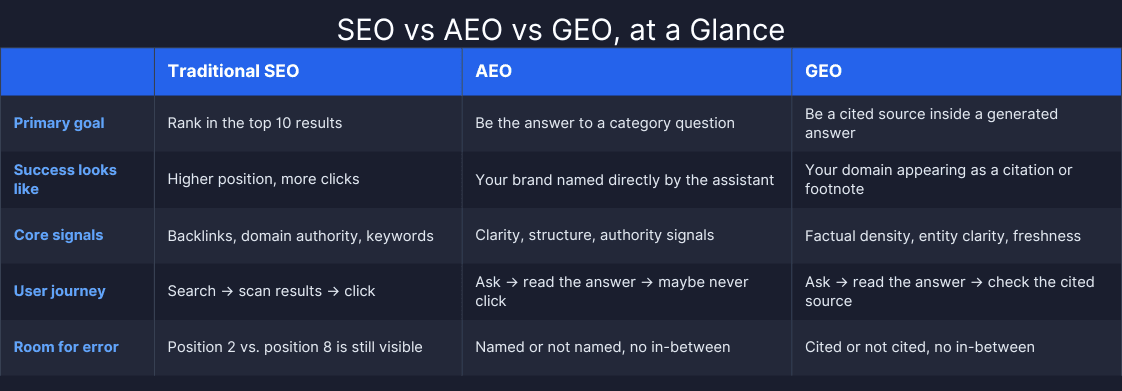
In the above table, the row that matters most is the last one. In traditional search engines, SEO has a long tail of visibility; position eight still gets some traffic. AEO and GEO don't. You're either part of the answer, or you don't exist for that query.
Where Google's Guidance Gets It Right
Google's mythbusting section is worth taking seriously, because it directly contradicts a lot of "GEO hacks" being sold as essential right now. Here's what Google says to leave alone, and what it recommends instead:
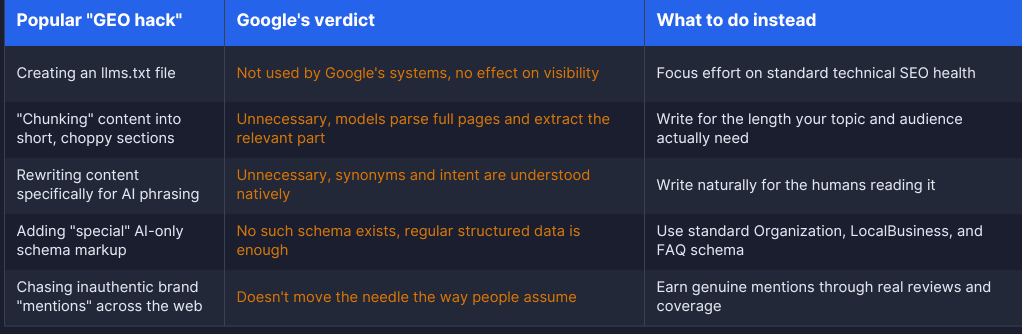
If an agency's entire GEO pitch is built around llms.txt files and content chunking, that's worth questioning before signing anything.
Where the "Still SEO" Framing Falls Short
Here's the nuance Google's guidance doesn't dwell on: even if the underlying ranking systems are the same, the outcome is structurally different. That difference changes how you should measure success.
Traditional SEO for traditional Google search is a game of positions. You can rank fourth, seventh, or twelfth, and still get meaningful traffic. AI-generated answers don't work that way, as the table above shows. The assistant typically names two or three sources, full stop. And the brands an AI system already trusts tend to get reinforced in future answers, which means early movers compound their advantage while everyone else finds it harder to break in later.
This is also why standard website analytics can be misleading right now. Analytics platforms show human visitors, not AI crawlers, so most businesses have no direct way to see whether AI platforms like ChatGPT or Gemini are reading their site at all, let alone recommending it. A common pattern worth watching for: organic search results and traffic quietly declining while direct traffic (people typing your business name straight into a browser) climbs at roughly the same rate. That's often a sign someone found you inside an AI assistant first.
Why This Matters More for South African Businesses, Not Less
Most AEO/GEO commentary is written with enterprise SaaS and B2B software in mind. But this isn't a hypothetical shift for South Africa; it's already live. Google confirmed at I/O 2026 that AI Mode is rolling out globally, South Africa included, meaning AI-generated answers are already appearing in local search results whether a given business has prepared for it or not.
The local market has clearly noticed. Over the past year, a growing number of South African digital agencies have started offering AI visibility, GEO, and AEO services specifically, running audits that check whether AI tools like ChatGPT, Perplexity, Gemini, and Google's AI features can find and cite a business by name. That's a reasonable signal that the space is still young enough locally for an early mover to get ahead of most competitors, rather than fighting for a place behind them once everyone else has caught up.
What's actually holding most South African businesses back isn't a lack of strategy; it's basic technical hygiene. Independent audits of local business websites keep surfacing the same handful of gaps: inconsistent business name, address, and phone details across a website, Google Business Profile, and directories; no structured data at all; thin, generic service pages that don't answer a real customer question; and pages that are difficult for crawlers to read in the first place. None of that requires manufactured AEO tricks; it requires the same technical and content discipline that has always mattered for SEO, applied properly.
What to Actually Focus On
Skip the manufactured tactics and put the effort into the things both Google and independent research agree are load-bearing:
- Write non-commodity content. Google's own example is a good one: "7 Tips for First-Time Homebuyers" is commodity content anyone could write. "Why We Waived the Inspection & Saved Money" is a first-hand, specific account that adds something an AI system can't get anywhere else.
- Keep your technical foundation clean. Your pages need to be crawlable, indexed, and eligible for a snippet before any AI feature can ever consider citing them. No amount of AEO effort compensates for a page that isn't indexed in the first place.
- Make your business a clear entity, not just a webpage. Consistent business name, address, registration numbers, and contact details across your site, Google Business Profile, and any directories help AI systems (and Google Search) map your business to the right query with confidence.
- Use structured data where it naturally fits. FAQ schema, LocalBusiness schema, Organization schema, as part of solid SEO practice, not as a magic AEO ingredient.
- Give people, and models, a fast path to a direct answer. A clear heading followed by a concise, factual paragraph outperforms three paragraphs of scene-setting before you get to the point.
FAQ's
IS AEO THE SAME AS GEO?
Almost. AEO covers direct-answer surfaces broadly; GEO narrows in specifically on generative engines like ChatGPT, Gemini, and Claude. In day-to-day practice, most agencies treat them as one combined discipline.
DO I NEED AN LLMS.TXT FILE TO BE CITED BY AI SEARCH?
No. Google has stated directly that its systems don't use llms.txt or similar files, and creating one has no measurable effect on your visibility in Google Search's AI features.
WILL GOOD SEO ALONE GET MY BUSINESS CITED IN AI ANSWERS?
It's the necessary foundation, but not sufficient on its own. A page still has to be indexed and technically sound to be eligible, but factual density, entity clarity, and non-commodity content are what tip the balance once that foundation is in place.
Keytakeaways
SEO isn't being replaced. But the surface where people find your business is splitting into two parts: the search results page and the AI-generated answer. Guidance from Google is a useful corrective against manufactured GEO tactics, but it shouldn't be read as "there's nothing new to do here." The businesses that get specific, factual, and technically clean now, while most of their local competitors are still ignoring the shift, are the ones AI assistants will keep naming a year from now. If you'd like to know where your business currently stands in AI-generated answers, get in touch with KwameTech Labs.
Wesley Lee
wesley@kwametechlabs.com